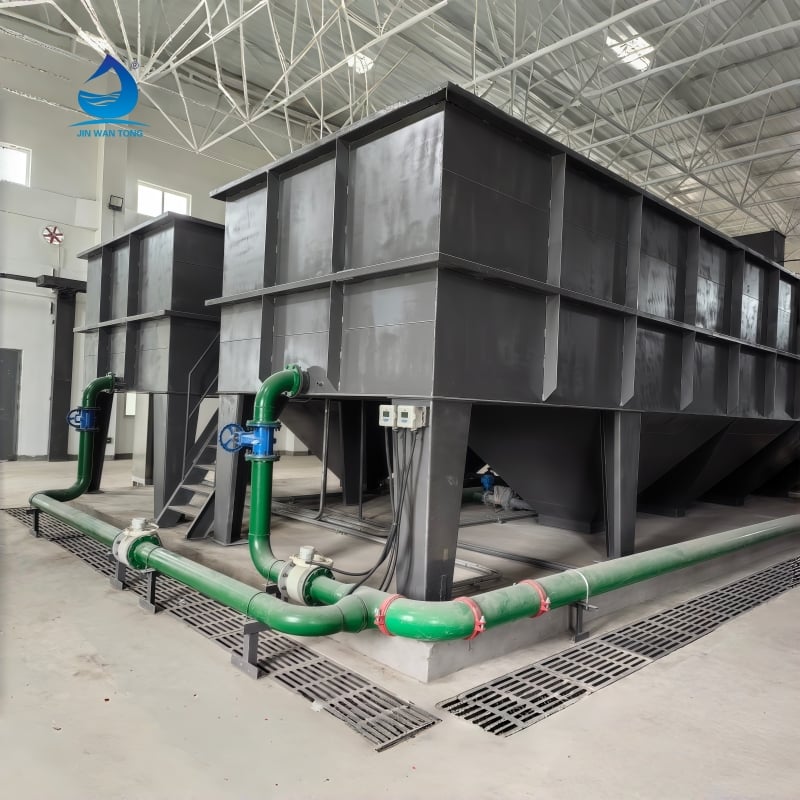
A clarifier tank fitted with tube settlers can handle higher flow, reduce suspended solids, and avoid costly civil expansion. This guide explains when tube settler media is worth adding, how it improves settling, and what buyers should check for retrofit, new-build, and water treatment clarifier projects.
Why a Tube Settler Improves a Clarifier Tank
A tube settler improves a clarifier tank by increasing the effective settling area inside the same footprint. Instead of forcing particles to settle through the full water depth, the inclined channels create many short settling paths, so solids can separate faster and more consistently.
In a conventional sedimentation tank, particles must travel a relatively long vertical distance before they reach the sludge zone. When the flow rises or floc quality changes, some solids may escape with the effluent. A tube settler reduces that distance. Once particles touch the inclined surface, they slide downward into the sludge collection area.
This makes solid liquid separation more efficient without adding mechanical drives or complex moving parts. For many plants, the result is similar to converting an old basin into a more compact high rate clarifier. A wastewater clarifier using this design can often treat more water, improve effluent clarity, and reduce downstream filter loading.
The practical value is simple: if the existing basin is hydraulically overloaded but still structurally usable, adding inclined settling media may be easier than building a larger tank.
Clarifier Tank Upgrade Benefits Without Major Civil Work
A clarifier tank upgrade with tube settlers is often chosen when the plant needs more capacity but has limited land, time, or construction budget. This is common in industrial ETPs, municipal wastewater plants, water reuse systems, and compact treatment units.
A new concrete basin can be expensive and slow to build. By comparison, installing a tube settler clarifier package inside an existing basin may reduce construction work and shorten shutdown time. For expansion projects, this can be especially valuable because the plant may need to keep running during installation.
Main advantages include:
1. Higher settling capacity in the same footprint
A clarifier tank with inclined media can increase the effective projected settling area, allowing more flow through the same structure.
2. Lower suspended solids in the outlet
Better solid liquid separation helps reduce turbidity and suspended solids, especially when upstream coagulation and flocculation are stable.
3. Reduced downstream maintenance
When tube settler media removes more solids, filters, membranes, and polishing systems receive a lower solids load.
4. Lower civil construction cost
Instead of adding another large basin, buyers may improve existing wastewater treatment equipment with modular media and support frames.
5. Faster path to capacity increase
A high rate clarifier design can be useful when production growth or stricter discharge standards require quick improvement.
The key decision is not only whether tube settlers work, but whether they solve the actual bottleneck. If the problem is poor flocculation, wrong pH, or insufficient sludge removal, media alone will not deliver the expected result.
When to Add Tube Settler Media to a Clarifier Tank
Tube settler media should be considered when a clarifier tank has enough basic hydraulic volume but lacks effective settling area. It is especially useful when the plant cannot easily expand the basin or when effluent suspended solids rise during peak flow.
A wastewater clarifier may benefit from this upgrade if the inlet distribution is reasonable, solids are settleable, and sludge withdrawal is working. An inclined tube settler system is not designed to fix every process failure, but it can greatly improve clarification when the upstream chemistry and flow pattern are already under control.
Consider adding tube settlers when:
1. The plant flow has increased
The original sedimentation tank may have been designed for a lower flow rate, and the surface loading may now be too high.
2. Effluent clarity becomes unstable during peaks
A tube settler clarifier can help maintain performance when short-term hydraulic surges disturb normal settling.
3. There is no room for another basin
A clarifier tank retrofit is often more practical than purchasing land or rebuilding the civil structure.
4. Downstream filters or membranes clog too often
A clarifier tank upgrade can reduce suspended solids before filtration, ultrafiltration, or MBR polishing.
5. The project needs compact water treatment equipment
For a water treatment clarifier in a packaged or modular system, inclined settling can help reduce the required footprint.
The best candidates are systems where flocs form well but do not have enough settling time or settling area. If flocs are weak, broken, oily, or floating, buyers should correct pretreatment first.
Design Points for an Inclined Tube Settler System
An inclined tube settler system must be designed around flow distribution, media geometry, sludge removal, and maintenance access. Good media cannot compensate for poor inlet hydraulics or a blocked sludge hopper.
The most common design concept uses inclined channels installed in the settling zone. A tube settler is often arranged at an angle that allows settled solids to slide down naturally. The exact angle, channel size, material, and module height should be selected according to water quality, sludge type, and hydraulic loading.
Compared with a
lamella clarifier, which usually uses inclined plates, tube settlers use honeycomb or tubular channels. Both designs follow the shallow settling principle, but the best choice depends on project layout, solids type, cleaning method, and supplier experience.
Buyers should check several practical details before ordering tube settler media:
1. Material selection
PP, PVC, or other materials may be used, depending on temperature, pH, chemical exposure, and project budget.
2. Support structure
The support frame must resist corrosion, carry the wet media load, and allow stable installation inside the basin.
3. Inlet and outlet distribution
Uneven flow can create short-circuiting, causing solids to bypass the settling zone.
4. Sludge withdrawal
Settled solids must be removed regularly; otherwise, they can accumulate, rise, or block the media.
5. Cleaning access
The system should allow inspection and flushing without complicated dismantling.
Qingdao
Jinwantong Environmental Science And Technology Co., Ltd. supports wastewater and water treatment projects with clarifier design, media selection, and integrated process equipment. For retrofit work, the company can help review existing tank dimensions, flow data, sludge properties, and installation limits before recommending a configuration.
What a Tube Settler Cannot Solve
A tube settler improves settling efficiency, but it cannot replace proper coagulation, flocculation, and sludge management. Buyers should avoid treating it as a universal cure for cloudy effluent.
If the upstream chemical dosing is wrong, particles may remain too fine to settle. If mixing is too strong, flocs may break before reaching the settling zone. If oil, grease, or floating solids dominate the wastewater, the problem may require skimming, DAF, or pretreatment rather than only inclined settling.
A clarifier tank may also underperform because of hydraulic short-circuiting, overloaded sludge hoppers, damaged launders, poor weir leveling, or irregular sludge discharge. In these cases, a full process check should come before media installation.
This is why many successful upgrades start with a simple diagnosis: confirm influent flow, solids concentration, floc quality, current surface loading, sludge blanket behavior, and effluent SS trends. Once the real limitation is known, the media design becomes much more reliable.
Final Recommendation for Clarifier Tank Projects
A clarifier tank with tube settlers is a practical solution when you need higher clarification capacity, better effluent quality, and a smaller footprint without major civil expansion. It is especially valuable for retrofit projects, compact plants, and treatment systems where settleable solids need faster separation.
If you are planning a clarifier tank upgrade, share your flow rate, tank dimensions, suspended solids level, sludge behavior, and target effluent quality with Qingdao Jinwantong. Our team can help evaluate whether tube settlers are the right choice and recommend a layout that fits your site conditions.
 EN
EN