 EN
EN
A dewatering screw press is often better for low-labor, compact, water-saving sludge treatment, while a belt press can fit larger continuous flows when wash water and skilled maintenance are available. This guide helps buyers compare both options by labor, water use, cake dryness, clogging risk, footprint, and total operating cost.
Dewatering Screw Press vs Belt Press: The Short Purchasing Answer
A dewatering screw press is usually the safer choice when your plant wants simple operation, low labor demand, lower wash water consumption, and compact installation. A belt press is more suitable when the project has high continuous throughput, enough wash water, sufficient space, and experienced operators.
For B2B buyers, the decision should not be based only on the machine price. The better question is: which sludge dewatering equipment gives the lowest total cost for your sludge type, site condition, and disposal method?
Both machines are used for sludge dewatering, but they work differently. A dewatering screw press slowly squeezes conditioned sludge through a screw shaft and filtration gaps. A belt filter press uses gravity drainage and roller pressure between two filter belts. Both can support continuous sludge dewatering, but their operation risks, maintenance points, and utility demands are different.
| Decision Factor | Dewatering Screw Press | Belt Press |
|---|---|---|
| Operation mode | Continuous, low-speed | Continuous, belt-based |
| Labor demand | Usually lower | Usually higher |
| Wash water use | Lower | Higher |
| Footprint | Compact | Larger layout |
| Cake dryness | Moderate to good | Moderate to good |
| Maintenance focus | Screw, screen, flocs | Belt, rollers, washing |
| Best fit | Industrial ETP, compact sites | Larger plants with trained staff |
The key takeaway: choose the machine that matches your operating reality, not the one that looks better in a brochure.
How a Dewatering Screw Press and Belt Filter Press Work
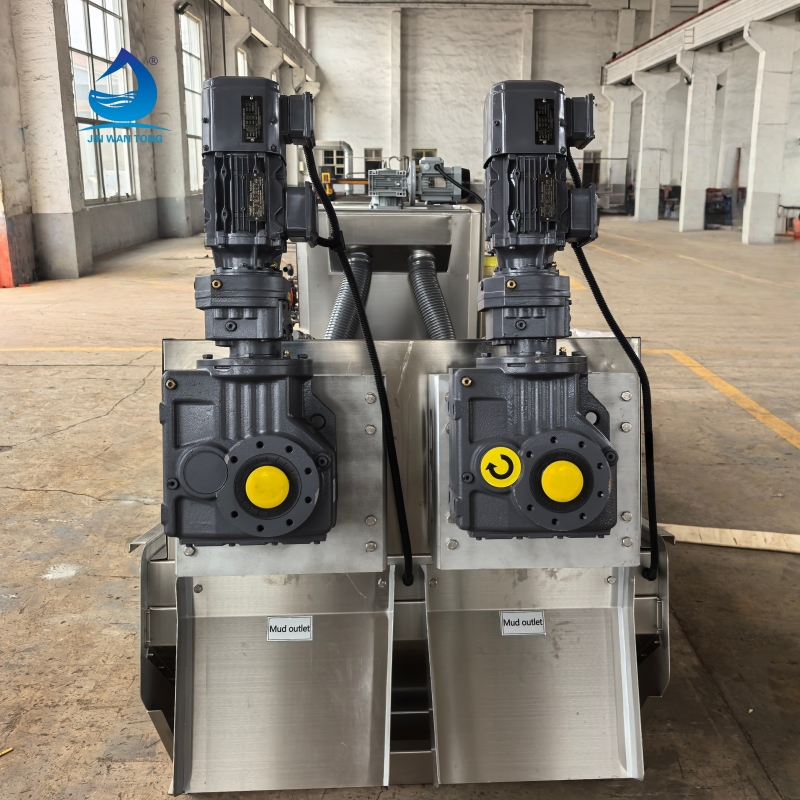
A dewatering screw press works by thickening and compressing flocculated sludge inside a slowly rotating screw structure. Water drains through filtration gaps, while solids move toward the discharge outlet and become cake.
This design makes the machine relatively enclosed, quiet, and easy to automate. It is commonly used in industrial sludge dewatering, especially for food wastewater, paper mill sludge, biological sludge, DAF sludge, dairy wastewater, and similar organic sludge.
A belt filter press works in three steps: chemical conditioning, gravity drainage, and pressure squeezing. Sludge is spread onto a moving filter belt, drained by gravity, then pressed between upper and lower belts through rollers. This makes it suitable for plants that need continuous processing and already have good wash water supply.
However, the belt press depends heavily on belt cleanliness, belt tension, roller alignment, and stable flocculation. If these are not controlled, sludge may squeeze out from the sides, filtrate may become cloudy, and cake moisture may increase.
Labor, Water, and Maintenance: Where Buyers Feel the Difference
A dewatering screw press generally needs less daily attention because it runs at low speed and does not require constant belt tracking. Operators mainly check polymer dosing, floc size, filtrate clarity, cake discharge, wash nozzles, and alarms.
A belt press often requires more hands-on management. Operators must monitor belt alignment, belt tension, spray washing, roller condition, sludge distribution, and side leakage. For plants with experienced operators, this may be manageable. For plants with limited staff, it can become a burden.
Wash water is another major difference. A belt filter press usually needs continuous high-pressure belt washing to prevent clogging. This adds water consumption and sends more return water back to the wastewater treatment system. In regions where water is costly or discharge volume is sensitive, this becomes a serious operating factor.
A dewatering screw press also needs cleaning, but usually with lower water demand. This is one reason it is popular in compact automatic sludge dewatering system designs.
| Cost Item | Dewatering Screw Press | Belt Press | Purchasing Impact |
|---|---|---|---|
| Operators | Lower requirement | Higher attention needed | Affects labor cost |
| Wash water | Usually lower | Usually higher | Affects utility and return flow |
| Energy use | Low-speed drive | Moderate | Depends on size |
| Spare parts | Screw/screen parts | Belt/roller/nozzle parts | Check local availability |
| Cleaning | Periodic or automatic | Continuous belt washing | Affects downtime |
| Site hygiene | More enclosed | More open | Affects working environment |
If your site has limited workers, limited water, or stricter housekeeping requirements, a dewatering screw press often has a practical advantage.
Cake Dryness: Which Sludge Dewatering Equipment Performs Better?
A dewatering screw press and a belt press can both produce acceptable cake, but cake dryness depends more on sludge characteristics and chemical conditioning than on equipment type alone.
Buyers often ask, “Which machine makes drier cake?” The honest answer is: it depends. Biological sludge, DAF sludge, food sludge, and paper sludge may behave differently. Polymer type, dosage, mixing time, feed solids concentration, and sludge age can change the result significantly.
A belt filter press may perform well on sludge that drains easily by gravity and forms strong flocs. A dewatering screw press may perform better where compact operation, steady feeding, and enclosed discharge matter more than achieving the driest possible cake.
If the project requires very low cake moisture for landfill cost reduction or incineration, buyers should also compare a filter press. In many cases, a filter press can produce drier cake, but it operates in batches and may require more discharge time or automation.
For wastewater sludge dewatering, the practical approach is to define your target first: lower labor, lower water use, drier cake, smaller footprint, or lower disposal cost. One machine rarely wins every category.
Which Sludge Types Fit Each Machine Better?
A dewatering screw press is usually a good match for sludge that can be flocculated well and does not contain too much abrasive sand or hard particles. A belt press is often suitable for larger flows and sludge that drains well on a belt surface.
| Sludge Type | Dewatering Screw Press | Belt Press |
|---|---|---|
| Biological sludge | Usually suitable | Suitable |
| DAF sludge | Usually suitable | Suitable |
| Food processing sludge | Usually suitable | Suitable, but cleaning matters |
| Paper mill sludge | Suitable | Often suitable |
| Municipal sludge | Suitable for small/mid scale | Common for large scale |
| Oily sludge | Use caution | Use caution |
| High-sand sludge | Wear risk | Belt wear risk |
| Fibrous sludge | Test recommended | Often suitable |
| Corrosive sludge | Material upgrade needed | Material upgrade needed |
For industrial sludge dewatering, the safest decision is to test the sludge or share detailed sludge data with the supplier. Sludge source, solids concentration, oil content, fiber content, pH, temperature, and chemical additives all influence machine performance.
Qingdao Jinwantong Environmental Science And Technology Co., Ltd. can support buyers with integrated wastewater treatment and solid liquid separation equipment selection, including process matching for dosing, DAF, clarification, and sludge discharge. This is useful when the buyer needs more than a standalone machine.
Screw Press vs Belt Press: Key Questions Before You Buy
A dewatering screw press should be selected when its operating benefits match your actual site conditions. Before choosing between screw press vs belt press, buyers should answer these questions:
- How many cubic meters of sludge must be treated per day?
- What is the feed solids concentration?
- Is sludge generated continuously or only during certain shifts?
- What cake moisture is acceptable for disposal?
- How much wash water is available?
- How many operators can manage the system?
- Is the site space limited?
- Does the sludge contain oil, sand, fiber, or corrosive chemicals?
- Is polymer dosing already tested?
- Are spare parts and service support available?
These questions help prevent a common mistake: buying sludge dewatering equipment based only on quoted capacity. Real capacity depends on sludge behavior, conditioning quality, and operating hours.
For example, if your plant lacks wash water, a belt press may create hidden costs. If your sludge contains heavy sand, a dewatering screw press may require stronger wear-resistant parts. If cake dryness is the only priority, neither option should be selected before comparing other technologies.
Long-Term Cost: Purchase Price Is Only One Part
A dewatering screw press may have a different purchase price than a belt press, but the real cost includes polymer, water, power, labor, spare parts, downtime, cake transport, and disposal fees.
A cheaper machine can become expensive if it produces wetter cake or needs frequent cleaning. A larger machine can also waste money if the actual sludge volume is small. For sludge dewatering, total cost should be calculated by annual operation, not only initial investment.
For continuous sludge dewatering, downtime matters. If the machine stops often, sludge accumulates and the ETP becomes unstable. This may affect production, odor control, storage, and compliance. Therefore, reliability and maintenance access should be part of the purchasing decision.
A well-designed automatic sludge dewatering system should include the main machine, polymer preparation, dosing pump, feed pump, control cabinet, washing system, filtrate return, and cake discharge arrangement. Without these supporting parts, even good sludge dewatering equipment may fail to deliver stable results.
Final Recommendation
A dewatering screw press is a strong choice for buyers who need low labor, compact layout, lower wash water demand, and stable wastewater sludge dewatering in industrial ETPs. A belt press is better when the plant has larger continuous flow, enough wash water, enough space, and operators who can manage belts, rollers, and washing systems.
If you are comparing a dewatering screw press with a belt press, share your sludge type, daily volume, solids content, target cake moisture, and site layout with Qingdao Jinwantong. Our team can help evaluate the right sludge dewatering equipment configuration and recommend a practical solution for your project.
Table of Contents
- Dewatering Screw Press vs Belt Press: The Short Purchasing Answer
- How a Dewatering Screw Press and Belt Filter Press Work
- Labor, Water, and Maintenance: Where Buyers Feel the Difference
- Cake Dryness: Which Sludge Dewatering Equipment Performs Better?
- Which Sludge Types Fit Each Machine Better?
- Screw Press vs Belt Press: Key Questions Before You Buy
- Long-Term Cost: Purchase Price Is Only One Part
- Final Recommendation