 EN
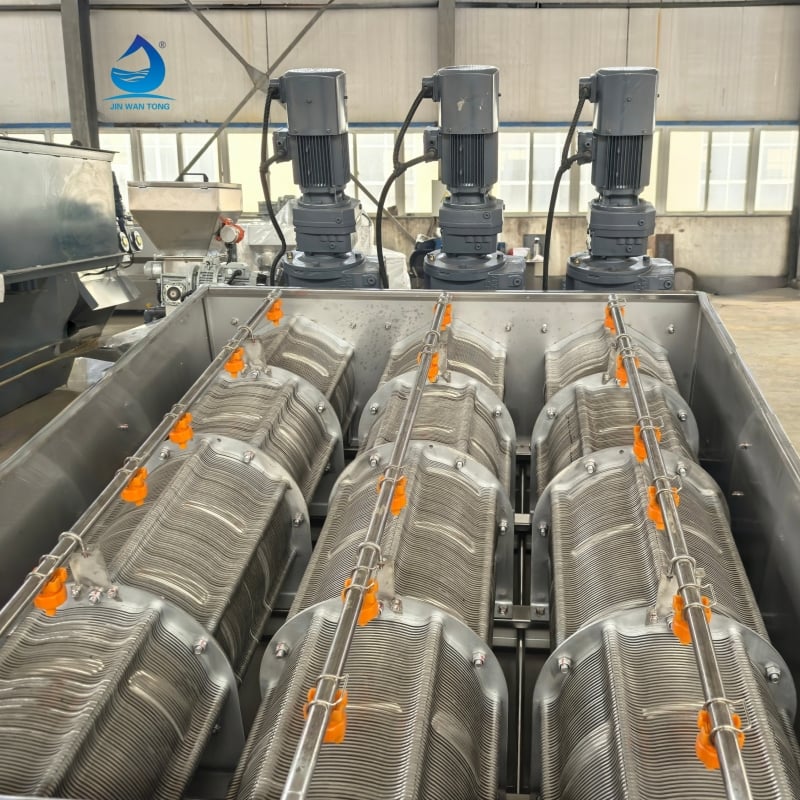
A sludge dewatering machine can only perform well when polymer conditioning creates strong flocs, releases water, and keeps filtrate clear. This guide explains how polymer dosing affects cake moisture, equipment capacity, clogging risk, chemical cost, and total sludge handling cost.
Why a Sludge Dewatering Machine Needs Polymer Conditioning
A sludge dewatering machine does not simply “squeeze water out” of raw sludge. Most sludge contains fine particles, colloids, biological solids, organic matter, and charged surfaces that hold water tightly. Without proper sludge conditioning, these particles remain dispersed, pass through screens or filter cloth, and produce cloudy filtrate.
Polymer changes the sludge structure before it enters the equipment. Through charge neutralization and bridging, a flocculant helps fine solids gather into larger, stronger flocs. These flocs drain faster, resist moderate mechanical stress, and allow the sludge dewatering equipment to separate water and solids more efficiently.
For buyers and operators, this means polymer is not a minor chemical. It directly affects sludge dewatering efficiency, cake dryness, filtrate clarity, processing capacity, and disposal cost. A well-selected polymer program can help a screw press, filter press, or belt press run more consistently.
How Polymer Dosing Improves Sludge Dewatering Efficiency
Correct polymer dosing improves sludge dewatering efficiency by making water easier to separate from solids. When flocs are strong and properly sized, free water drains quickly, while solids remain in the cake.
In practical operation, good polymer conditioning can provide several benefits. It can reduce fine solids in filtrate, increase the feed rate of a sludge dewatering machine, lower cake moisture, reduce screen or cloth blinding, and improve cake discharge. These improvements can help the plant process more sludge within the same working hours.
However, the goal is not to add as much polymer as possible. The goal is to find the optimum dose. Too little polymer creates weak flocs and dirty filtrate. Too much polymer may create sticky sludge, increase chemical cost, block screens, and make cake removal harder. This is why polymer dosage optimization in wastewater treatment should be based on testing and daily monitoring.
A good dosing program usually checks floc size, filtrate clarity, cake texture, equipment torque or pressure, and polymer consumption together. Looking at only one indicator can mislead operators.
Polymer Conditioning and Cake Moisture
A sludge dewatering machine produces drier cake when conditioned sludge releases water quickly and forms a stable solids network. Polymer helps by reducing the amount of water trapped between fine particles and by improving cake structure.
Cake moisture is affected by sludge type, feed solids concentration, polymer type, polymer dose, mixing strength, equipment settings, and operating time. For example, biological sludge often needs a cationic polymer because many biological solids carry negative charge. Inorganic sludge or mineral slurry may respond better to an anionic polymer, depending on particle charge and chemistry.
Polymer alone cannot guarantee a fixed cake moisture. If sludge is too dilute, oily, salty, toxic, or poorly mixed, the dewatering result may still be unstable. A sludge dewatering machine also needs correct feed pressure, screw speed, belt tension, chamber pressure, or centrifugal force depending on the equipment type.
This is why the question should not be “Which polymer gives the driest cake?” The better question is: “Which polymer, dose, mixing condition, and machine setting give the lowest total sludge handling cost?”
What Happens When Polymer Dosing Is Wrong
Wrong polymer dosing can make an expensive sludge dewatering machine look ineffective. Many performance problems blamed on the machine are actually caused by weak conditioning, poor polymer preparation, or unstable sludge quality.
| Problem | Likely Polymer-Related Cause | Operating Impact |
|---|---|---|
| Wet cake | Under-dosing, wrong polymer type, weak flocs | Higher transport and disposal cost |
| Cloudy filtrate | Flocs too small or broken | More solids returned to treatment system |
| Sticky sludge | Over-dosing or poor dilution | Screen or cloth blockage |
| Low capacity | Slow drainage or clogged media | Longer operating hours |
| High chemical cost | No dose control or no jar testing | Higher OPEX |
| Unstable performance | Feed sludge variation | Frequent manual adjustment |
Operators should avoid reacting to every wet cake problem by increasing polymer. Sometimes the solution is better dilution, longer maturation, gentler mixing, improved feed solids concentration, or a different product.
Polymer Dosing for Different Sludge Dewatering Equipment
Different sludge dewatering equipment requires different floc strength and drainage behavior. A polymer that works well for one machine may not work well for another.
For a screw press, flocs must be strong enough to stay on the screen while water drains through the gaps. If flocs are too weak, solids pass into the filtrate. If sludge becomes too sticky, the screen may clog and the cake outlet may become unstable.
For a filter press, polymer conditioning should improve filtration speed and cake release. Good flocs reduce fine particle migration into filter cloth, helping prevent blinding and reducing cycle time. Poor conditioning may cause long filtration cycles and wet, sticky cake.
For a belt press, sludge must release water during gravity drainage and then withstand roller pressure. Flocs should not collapse too early, and the cake should separate from the belt surface. If the polymer is wrong, sludge may squeeze out from the sides or require excessive wash water.
For a centrifuge, flocs must resist high shear. Some polymers that work in low-speed systems may break under centrifugal force. Therefore, polymer trials should be matched with the actual sludge dewatering machine, not only with a beaker test.
Polymer Preparation System and Dosing Stability
A polymer preparation system is critical because even the right polymer fails if it is not properly dissolved, matured, and delivered. Powder polymer needs enough wetting, dilution, mixing, and aging time. Emulsion polymer may dissolve faster but still requires correct dilution and feeding.
Common preparation problems include fish-eyes, uneven concentration, excessive mixing shear, old polymer solution, clogged dosing lines, poor dilution water, and unstable dosing pump flow. These issues can cause sudden changes in filtrate clarity and cake moisture even when the machine settings remain unchanged.
An automatic polymer dosing system helps stabilize concentration and feed rate. It can reduce operator error, keep polymer solution consistent, and support continuous dewatering. For larger plants, dosing control may be linked with sludge feed flow, solids concentration, or equipment load.
Qingdao Jinwantong supports customers by focusing on practical wastewater operation needs, stable product quality, and responsive service communication. In sludge treatment projects, consistent polymer preparation and dosing reliability are often as important as the main equipment model.
Cost Impact: Chemical Cost vs Disposal Cost
A sludge dewatering machine should be evaluated by total cost, not only polymer consumption. Reducing polymer too much may save chemical cost but produce wetter cake, increasing transport and disposal fees. Overdosing may improve appearance slightly but waste chemicals and increase maintenance problems.
A practical cost evaluation should include:
- Polymer cost per ton of dry solids;
- Cake moisture and disposal cost;
- Filtrate return load to the wastewater system;
- Operating hours and energy consumption;
- Labor required for adjustment and cleaning;
- Screen, belt, or filter cloth replacement;
- Downtime caused by blockage or unstable conditioning.
The best polymer program is the one that gives stable performance at the lowest total sludge handling cost. In many plants, a small improvement in cake dryness or reduced filtrate solids can be worth more than a small reduction in chemical dose.
Final Recommendation
A sludge dewatering machine depends heavily on polymer conditioning to achieve stable capacity, clear filtrate, manageable cake, and controlled operating cost. Proper polymer dosing, reliable preparation, and regular adjustment are essential for improving sludge dewatering efficiency.
If your plant struggles with wet cake, cloudy filtrate, high polymer use, or frequent clogging, review the polymer program before replacing the equipment. Contact Qingdao Jinwantong to discuss sludge characteristics, dosing stability, and practical optimization options for your dewatering process.
Table of Contents
- Why a Sludge Dewatering Machine Needs Polymer Conditioning
- How Polymer Dosing Improves Sludge Dewatering Efficiency
- Polymer Conditioning and Cake Moisture
- What Happens When Polymer Dosing Is Wrong
- Polymer Dosing for Different Sludge Dewatering Equipment
- Polymer Preparation System and Dosing Stability
- Cost Impact: Chemical Cost vs Disposal Cost
- Final Recommendation