 EN
A sludge dewatering machine can produce very different cake dryness depending on equipment type, sludge properties, and polymer conditioning. This guide compares typical dry solids content, explains why real results vary, and helps buyers choose sludge dewatering equipment based on disposal cost, throughput, and operating priorities.
Sludge Dewatering Machine Results: What Dry Solids Content Means
A sludge dewatering machine separates water from sludge to create a sludge cake with higher solids concentration. Dry solids content means the percentage of solids in the cake after dewatering. If a cake has 25% dry solids, the remaining 75% is moisture.
This number matters because sludge is usually paid for by weight, volume, transport distance, landfill cost, or incineration demand. A higher sludge cake dryness can reduce hauling trips, storage space, leachate risk, and downstream disposal cost.
However, buyers should not treat dry solids content of sludge cake as a fixed machine label. The same dewatering machine may produce different results when processing biological sludge, chemical sludge, mineral slurry, oily sludge, or food processing sludge. Polymer type, feed solids concentration, cycle time, pressure, speed, and operator control all affect final performance.
The practical purchasing question is not “which machine gives the highest number?” The better question is: “Which sludge dewatering equipment gives the best balance of cake dryness, capacity, labor, energy, maintenance, and disposal cost for my sludge?”
Typical Dry Solids Content by Dewatering Machine
A sludge dewatering machine should be compared using realistic ranges, not brochure promises. The values below are common industry reference ranges based on general wastewater treatment practice, but they are not guaranteed for every project.
| Dewatering Machine | Typical Dry Solids Content | Main Strength | Common Limitation |
|---|---|---|---|
| Screw press | 15–25% DS | Continuous, low labor, low energy | Moderate cake dryness |
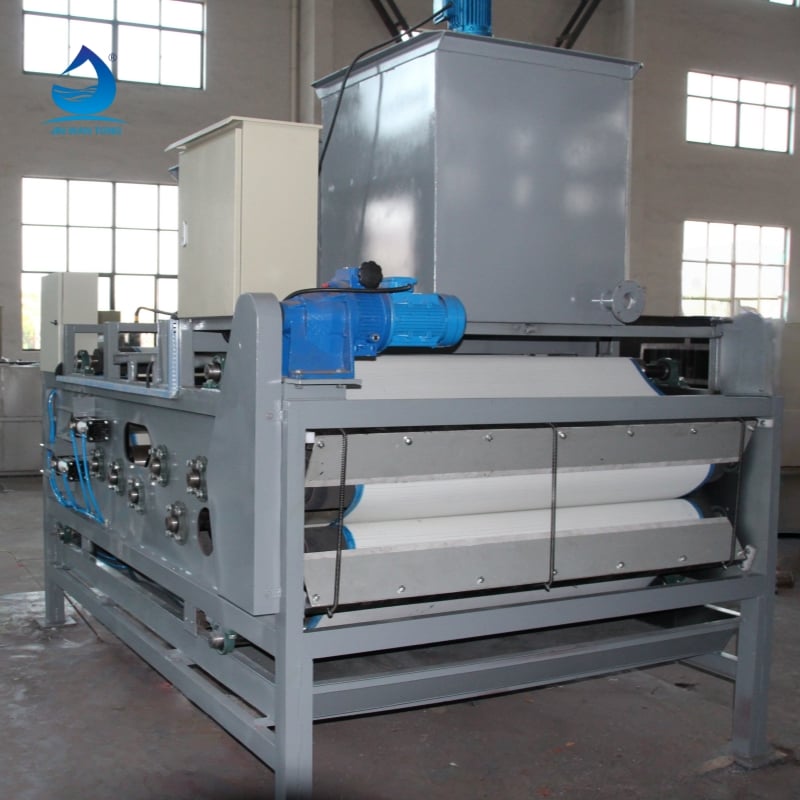
| Belt press | 15–25% DS | Continuous, suitable for larger flow | Needs wash water and belt care |
| Centrifuge | 18–30% DS | Compact, automated, high throughput | Higher energy and maintenance |
| Filter press | 25–45% DS | Higher cake dryness, clearer filtrate | Batch operation, longer cycle |
| Drying bed | 20–40% DS | Low equipment cost | Slow, weather-dependent |
A screw press dry solids content range is often suitable for plants that value continuous operation and low manpower. A filter press dry solids content range is usually higher, especially for chemical or inorganic sludge, but the buyer must accept batch operation and possible longer cycle time.
A belt press vs screw press cake dryness comparison often shows similar ranges, but their operating needs differ. A belt press generally needs more wash water and belt maintenance, while a screw press is more compact and easier to automate. A centrifuge may achieve good dryness with strong automation, but power use and precision maintenance should be reviewed.
For buyers, the table should be used as a starting point, not a final guarantee.
Why Actual Sludge Cake Dryness Varies
Actual sludge cake dryness varies because sludge behavior is often more important than equipment name. A sludge dewatering machine can only perform well when sludge releases water effectively.
Biological sludge is usually harder to dewater because water is trapped in microbial flocs and cell structures. Mineral sludge may reach higher dry solids content because particles are dense and drain more easily. Oily sludge can be difficult because oil interferes with polymer conditioning and blocks screens or filter cloth. Chemical sludge can vary widely depending on coagulants, pH, precipitates, and dissolved salts.
Several factors decide the final cake result:
-
Sludge type and composition
Organic, inorganic, oily, fibrous, or chemical sludge behaves differently during wastewater sludge dewatering. -
Feed solids concentration
Very dilute sludge reduces capacity and may produce unstable cake. -
Polymer conditioning
Correct polymer improves floc strength and water release; poor dosing causes wet cake or dirty filtrate. -
Equipment settings
Screw speed, belt tension, centrifuge G-force, or filter press cycle time directly affect results. -
Operating priority
Higher dryness may require lower throughput, more polymer, more energy, or longer operating time.
This is why what affects dry solids content in sludge dewatering should be discussed before quoting a machine. If the project requires guaranteed performance, sludge testing is much safer than relying only on a catalog.
How Dry Solids Content Affects Disposal Cost
A sludge dewatering machine directly affects disposal cost because even small changes in dry solids content can change sludge weight significantly. When cake dryness increases, total water content decreases, and less material must be transported or treated.
For example, sludge cake at 20% DS contains 80% water. Cake at 30% DS contains 70% water. That difference may look small, but over hundreds or thousands of tons per year, it can reduce truckloads, landfill fees, drying demand, or incineration fuel use.
However, the highest sludge cake dryness is not always the lowest total cost. A filter press may make drier cake, but it may require more labor, longer cycle time, higher structure cost, or more automation. A screw press may produce slightly wetter cake, but it may reduce labor and energy. A centrifuge may save space, but electricity and maintenance can be higher.
Therefore, sludge disposal cost should be evaluated with chemical cost, power cost, maintenance cost, operator cost, downtime risk, and final cake handling method. For incineration, higher dryness is often valuable. For short-distance transport to low-cost disposal, lower labor may matter more.
How to Choose a Machine Based on Target Dry Solids
A sludge dewatering machine should be selected according to the target dry solids, sludge type, and disposal route. Choosing the highest-dryness option without considering operation can create unnecessary cost.
If the priority is continuous low-labor operation, a screw press may be practical for biological sludge, DAF sludge, food wastewater sludge, and municipal-type sludge. If the project needs large continuous processing and has enough wash water, a belt press may be suitable. If the site needs compact automation and can manage higher energy and maintenance, a centrifuge may be considered. If the project needs high dry solids content and can accept batch operation, a filter press is often worth evaluating.
For industrial sludge dewatering, sludge testing is especially important. Chemical, textile, metal finishing, mining, and food processing sludge can respond very differently to the same sludge dewatering equipment. A wrong equipment choice may cause wet cake, low capacity, frequent clogging, and higher total cost.
Qingdao Jinwantong works with buyers by focusing on realistic application data, stable product quality, and practical service communication. For dewatering projects, sharing sludge data and disposal goals helps match equipment expectations with operating reality.
What Buyers Should Ask Before Trusting a Dry Solids Claim
A sludge dewatering machine supplier should explain the basis of any cake dryness claim. If a value is presented without sludge type, feed solids, polymer condition, and operating mode, it may not reflect your site.
Before purchasing, ask:
- Was the quoted dry solids content based on actual sludge testing?
- What feed solids concentration was assumed?
- What polymer type and dosage were used?
- Is the result based on continuous operation or short test operation?
- What throughput is achievable at the target cake dryness?
- What happens if sludge quality changes seasonally?
- What filtrate quality can be expected?
- What maintenance is required to keep performance stable?
These questions help prevent a common mistake: accepting a high cake dryness number without understanding the operating conditions behind it.
Final Recommendation
A sludge dewatering machine should be selected using realistic dry solids content, sludge characteristics, disposal route, and total operating cost—not brochure values alone. A filter press may offer higher cake dryness, while a screw press, belt press, or centrifuge may be better when continuous operation, labor saving, or compact layout is the priority.
If you need to compare sludge dewatering equipment for your project, share your sludge source, feed solids, daily volume, target cake dryness, and disposal method with Qingdao Jinwantong. Our team can help you review practical options and avoid overpaying for performance your sludge may not actually achieve.
Table of Contents
- Sludge Dewatering Machine Results: What Dry Solids Content Means
- Typical Dry Solids Content by Dewatering Machine
- Why Actual Sludge Cake Dryness Varies
- How Dry Solids Content Affects Disposal Cost
- How to Choose a Machine Based on Target Dry Solids
- What Buyers Should Ask Before Trusting a Dry Solids Claim
- Final Recommendation