 EN
EN
How Does a DAF System Remove Suspended Solids, Fats, and Oils?
Industrial wastewater from food processing, slaughterhouses, textile manufacturing, and petrochemical plants often contains high levels of total suspended solids (TSS) as well as fats, oils, and grease (FOG). Left untreated, these contaminants can severely clog municipal sewer networks, damage downstream filtration equipment, and cause non-compliance with environmental regulations.
One of the most effective physical-chemical pretreatment technologies used globally to solve this problem is dissolved air flotation. But how exactly does this system clarify heavily contaminated wastewater so efficiently? In this article, we break down the step-by-step mechanism of how a DAF unit removes TSS and FOG from industrial effluent.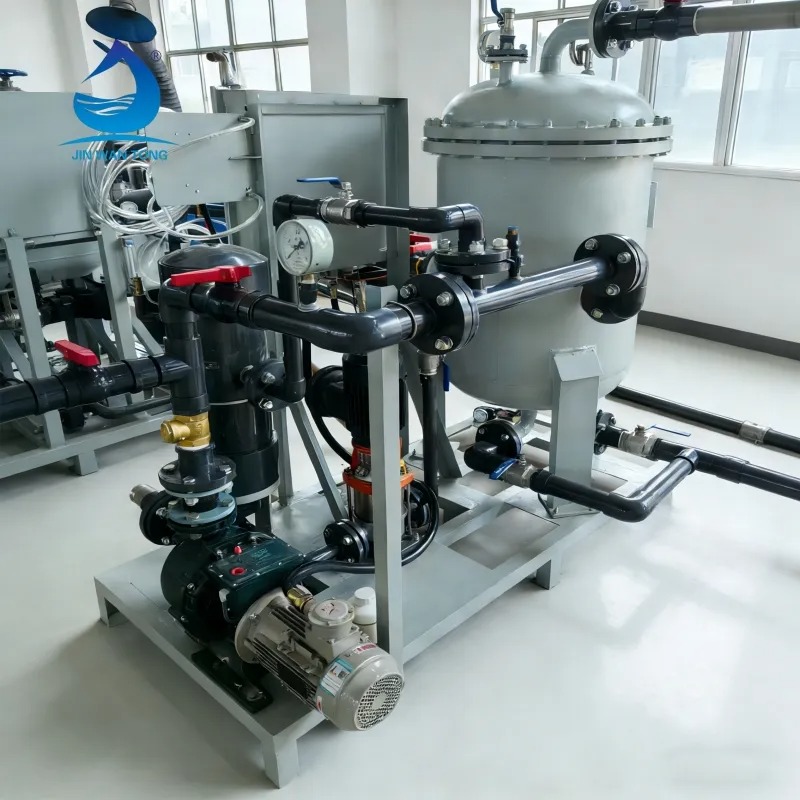
What is Dissolved Air Flotation?
dissolved air flotation is a water clarification process that removes suspended matter such as oil, grease, and fine solids by dissolving air in water under pressure and then releasing the air at atmospheric pressure in a flotation tank.
The released air forms millions of microbubbles that attach to suspended particles, causing them to float to the surface where they can be continuously skimmed off.
Step-by-Step: How a DAF System Cleans Wastewater
1. Coagulation and Flocculation (Chemical Pretreatment)
Before entering the main flotation tank, wastewater passes through a pipe flocculator or reaction tank. Coagulants (like PAC) and flocculants (like PAM) are added to neutralize particle charges and bind small suspended particles together into larger, more stable masses called flocs.
2. Air Dissolution and Microbubble Generation
A portion of the clarified water from the DAF outlet is recycled back into a pressure vessel called a saturation tank or recycle pump. Compressed air is injected into this recycled stream under high pressure (typically 4 to 6 bar), forcing the air to dissolve into the water.
3. Pressure Release and Flotation
When this air-saturated water is injected into the inlet of the flotation basin, the pressure drops abruptly back to atmospheric pressure. This sudden depressurization causes the dissolved air to instantly release billions of microscopic air bubbles (typically 10 to 50 microns in diameter).
4. Particle Attachment and Rising
The tiny microbubbles attach themselves to the chemical flocs, emulsified fats, and oils. Because the bubble-particle agglomerates have a lower density than water, buoyant forces push them rapidly upward to the surface of the flotation basin, forming a dense floating sludge blanket.
5. Sludge Skimming and Clean Water Discharge
A continuous mechanical chain skimmer sweeps the floating sludge layer into a collector hopper for further dewatering. Meanwhile, clarified water near the bottom of the tank flows over an adjustable weir and exits the system, ready for secondary biological treatment or discharge.
What Contaminants Can a DAF System Remove?
Total Suspended Solids (TSS): Efficiently separates insoluble organic and inorganic particles down to fine suspended matter.
Fats, Oils, and Grease (FOG): Effectively breaks emulsified oils and floats free grease, achieving removal efficiencies often exceeding 95%.
Chemical Oxygen Demand (COD) and BOD: By removing organic suspended solids and fats, a DAF system significantly lowers overall organic load before biological processing.
Why High-Efficiency Dissolved Air Flotation Matters for Your ETP
Implementing modern dissolved air flotation technology provides several crucial advantages for industrial effluent treatment plants (ETPs):
Small Footprint: High surface loading rates mean DAF units require far less space than traditional gravity sedimentation clarifiers.
High Removal Efficiency: Microbubble flotation yields superior separation rates for low-density or buoyant particles like oil and grease.
Reduced Sludge Volume: The skimmed surface sludge typically has a higher solid concentration than settled sludge, lowering sludge handling costs.
Advanced Dissolved Air Flotation Solutions from Tsingtao JWT
At Tsingtao JWT, we engineer and manufacture custom dissolved air flotation equipment tailored to various industrial wastewater challenges. Built with corrosion-resistant materials and energy-efficient saturation systems, our DAF units provide stable performance, minimal maintenance, and long service lives for clients worldwide.
Whether upgrading an existing wastewater facility or designing a new industrial treatment plant, integrating a tailored DAF unit ensures optimal separation efficiency and lower operational expenses.
Frequently Asked Questions (FAQ)
Q1: What is the main difference between sedimentation and dissolved air flotation?
A: Sedimentation relies on gravity to settle heavy particles to the bottom of a tank, whereas dissolved air flotation uses microbubbles to float light, buoyant, or emulsified particles (like oil, grease, and algae) to the surface.
Q2: What microbubble size is ideal for dissolved air flotation?
A: Microbubbles in the range of 10 to 50 microns are ideal. Bubbles in this size range easily adhere to small chemical flocs without breaking them apart.
Q3: Are chemicals always required in a DAF system?
A: While DAF can remove some free oils and coarse solids without chemicals, adding coagulants and flocculants dramatically improves removal efficiency for emulsified oils, fine suspended solids, and colloidal matter.
Q4: How much TSS and FOG can a DAF system remove?
A: Under optimal chemical dosing and operational conditions, high-performance dissolved air flotation systems can remove up to 90-98% of FOG and 90-95% of TSS.
Table of Contents
- How Does a DAF System Remove Suspended Solids, Fats, and Oils?
- What is Dissolved Air Flotation?
- Step-by-Step: How a DAF System Cleans Wastewater
- What Contaminants Can a DAF System Remove?
- Why High-Efficiency Dissolved Air Flotation Matters for Your ETP
- Advanced Dissolved Air Flotation Solutions from Tsingtao JWT
- Frequently Asked Questions (FAQ)